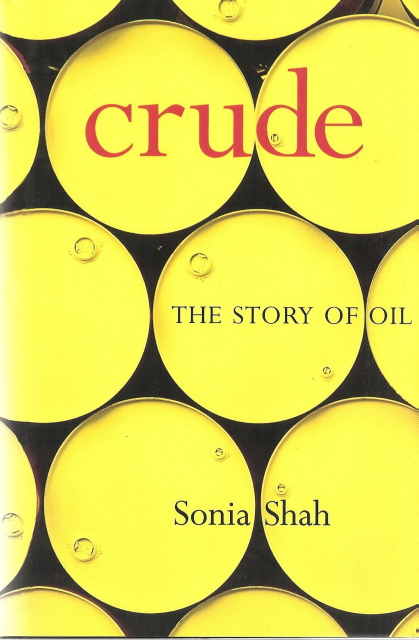
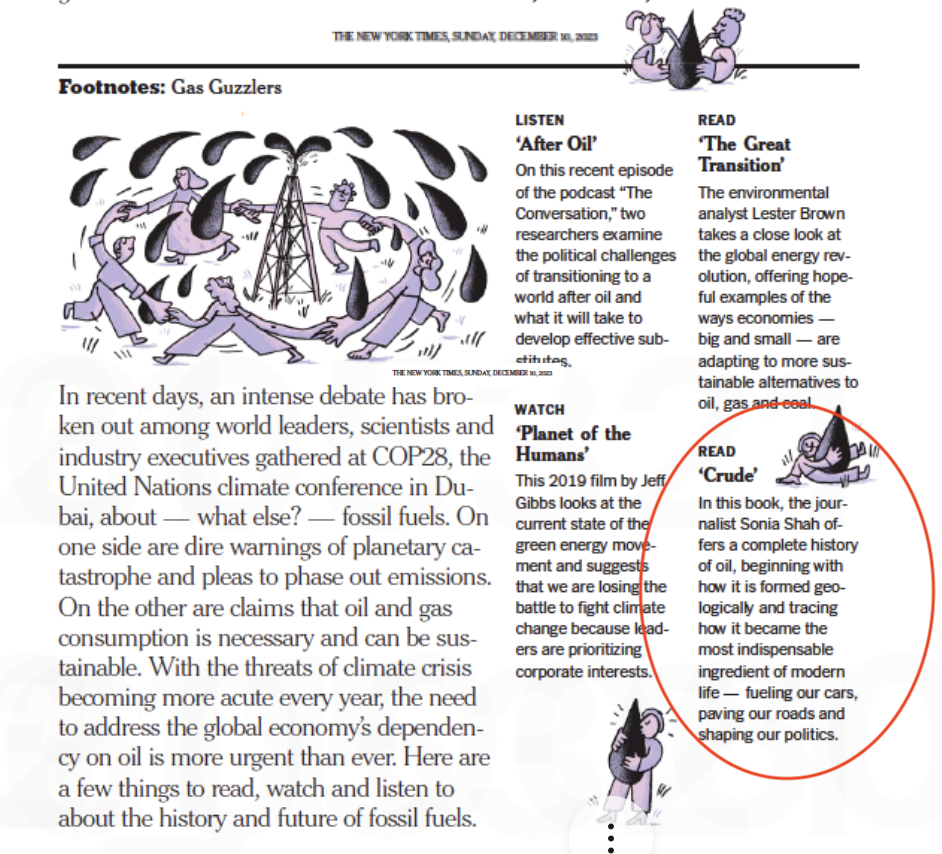
“A complete history of oil.” -New York Times, December 9, 2023
Crude is the unexpurgated story of oil, from the circumstances of its birth millions of years ago to the spectacle of its rise as the indispensable ingredient of modern life. In addition to fueling our SUVs and illuminating our cities, crude oil and its byproducts fertilize our produce, pave our roads, and make plastic possible. “Newborn babies,” observes author Sonia Shah, “slide from their mothers into petro-plastic-gloved hands, are swaddled in petro-polyester blankets, and are hurried off to be warmed by oil-burning heaters.” The modern world is drenched in oil; Crude tells how it came to be. A great human drama emerges, of discovery and innovation, risk, the promise of riches, and the power of greed.
Shah infuses recent twists in the story with equal drama, through chronicles of colorful modern-day characters — from the hundreds of Nigerian women who stormed a Chevron plant to a monomaniacal scientist for whom life is the pursuit of this earthblood and its elusive secret. Shah moves masterfully between scientific, economic, political, and social analysis, capturing the many sides of the indispensable mineral that we someday may have to find a way to live without.
“If someone sitting in air-conditioned comfort in one part of the world believes that what happens in Iraq or Nigeria, Venezuela or Colombia doesn’t affect him or her, Sonia Shah’s Crude: The Story of Oil takes that little daydream and shakes it up…[Shah] has written a book that couldn’t be more relevant.” —USA Today
“Shah has written a brilliant book—This is not a Michael Moore-style anti-corporate rant—Shah writes beautifully, with dispassionate, elegant clarity—and it is all the more powerful for it.” —The Guardian
“Her compelling account illuminates how oil reserves came to be and how this cheap fuel shaped the U.S. auto industry, contributed to human-rights abuses and rapid climate change, and created the ‘petrolife’ Americans enjoy today.” –Sierra magazine
“A definitive new book on oil.” —Playboy magazine“Challenging current attempts at obfuscation and oversimplification, Sonia Shah’s Crude: The Story of Oil tackles an issue that has fueled society, politics, and environmental destruction for over 100 years.” In the Fray magazine
“Sonia Shah—deftly [shows] how the oil companies’ relentless pursuit of new fields to exploit has led them to drill for oil in some of the most impoverished and unstable areas of the world—particularly eloquent on the despoliation of the Delta region of southern Nigeria.” —The Nation“Though Shah could have easily written a laundry list on the disruptions Big Oil and its government cohorts continue to wreak, this volume is more than that – it is an insightful missive to her readers to understand their consumptive reality. In her steady tone, she presents the danger signs—When she looks into a sci-fi future where humankind interfaces with the next great epoch of crude, the scene shows moment that Shah eloquently challenges us to rise to—right here and now.” —Clamor magazine“Sonia Shah is an elegant writer and her captivating history of the world’s most critical natural resource is impossible to put down. The lure of “black gold” haunts every page as Shah illuminates the roots of our prime energy source, the science, the economics, the lore and the politic…how our obsession with oil began and how it dominates our existence. Indeed, to understand the story of oil, one must dig deep. The author begins with its birth, hundreds of millions of years ago and brings us to the exploration and exploitation of today. Herein lies the mystery of the planet’s future and the fate of mankind. Crude is so compelling you will soar through its pages and share it with others. It’s surely one of the most important books of the year.” -Dingbat magazine: the monthly review of cool tools





i would like to know if the book ‘crude’ has been translated in to either Turkish or German.
thank you.
Hi Sukru,
“Crude” has been translated into a number of languages, but not German or Turkish. You can find out more about foreign editions of the book here: http://soniashah.com/outside-the-us/
Thanks for your interest!
Sonia
I got good news for you Sonia. The earths magnetic field turns underground water into oil. Everything you know about crude is WRONG. At magneticwaterscience.com there is a password protected video of turning fresh water into crude oil and burning it. We have done this experiment many times. By reversing the magnetic fields we have also turned oily saline water into potable drinking water. For every action there is an opposite and equal reaction.
I invite you to open up dialogue with myself to understand this process more thoroughly. Perhaps a demonstration? It is a little highly classified as the entire world is based upon the ‘fossil’ fantasy and they kill to protect it but nevertheless, eventually our ‘Field Science’ will prevail.
Looking forward to reading your book after being impressed with your talk on cspan’s booktv several years ago while it was being released.
I’m hearing a lot of talk on PBA which apparently breaks down and currently preferred by coin collectors and environmentally conscious person(s) such as myself. During your talk you may have delved much further into the subject matter OIL (giving viewers) or your audience without much reason to inquire further about by reading your book.
I have several books to read first and “Crude” has been at the forefront of books I want to read since being released. I am off to sleep 💤
Tom